











Table of contents
X-ray WMD Detection in Public Spaces
FOCUS: Detecting CBRN threat components, including shielded radioactive sources, chemical and biological dispersal devices, IED initiators, and hidden compartments, in baggage, cargo, vehicles, and on or inside the body
APPLICATION: Airports and air cargo, stadiums and event venues, seaports and land borders, government buildings, critical infrastructure, and military installations
SOLUTION: AI-driven baggage, body, cargo and vehicle, and mobile X-ray solutions with material discrimination for WMD detection
Weapons of mass destruction (WMDs) are a low-probability, high-consequence threat. An attack is unlikely on any given day, but a single successful one can cause mass casualties, long-term contamination, and economic disruption far beyond the target site. For security leaders at airports, stadiums, ports, government campuses, and military installations, the practical question is not whether the risk is real but how to build screening that intercepts it.
At the facility level, WMD detection rarely means finding the chemical, biological, or radiological agent itself. It means finding the hardware that carries it: the shielded container, the pressurized dispersal device, the detonator and wiring, the false compartment in a vehicle. Understanding a WMD’s physical signature is what makes X-ray imaging the central layer of most screening programs, and it is why the choice of defense equipment X-ray configuration and the quality of the material discrimination security system behind it directly shape detection outcomes.
This guide covers the threat, the policy framework in the United States and abroad, how X-ray detection actually works, what it can and cannot see, the main system types, deployment by facility, and the criteria that matter when evaluating equipment.
What Counts as a WMD Threat
US and allied doctrine groups WMDs into four categories, commonly abbreviated as CBRN: chemical, biological, radiological, and nuclear. Each poses a different detection challenge.
Chemical weapons use toxic agents such as nerve, blister, or choking agents. They typically require a sealed container and a release mechanism, such as a sprayer, aerosol canister, or small explosive charge. Biological weapons use pathogens or toxins and likewise depend on containment and dispersal hardware. Radiological weapons, including radiological dispersal devices (RDDs, often called “dirty bombs”), combine radioactive material with conventional explosives or another means of spreading contamination. Nuclear weapons and improvised nuclear devices require special nuclear material and are the least likely but most destructive scenario.
What these threats share is concealment. A WMD’s most vulnerable point is transport: before it can be used, its components have to be moved to the target. They can be hidden in carry-on bags, parcels, vehicles, shipping containers, or on and inside a person. Crowded public spaces are attractive targets precisely because they combine dense populations with high throughput and limited time per screening. The European Commission’s 2017 action plan on public space protection was developed in direct response to attacks on crowded places in Barcelona, London, Manchester, and Stockholm, and the parallel EU CBRN action plan acknowledged that while CBRN attacks are considered low likelihood, even a small-scale incident can have outsized impact1.
WMD Countermeasures Policy in the US and Other Countries
Screening requirements for a specific site come from a mix of national doctrine, agency programs, and international obligations. Knowing this framework helps security managers justify investments and align with partner agencies.
The International Baseline: UN Security Council Resolution 1540
UN Security Council Resolution 1540, adopted unanimously in 2004 under Chapter VII of the UN Charter, is binding on every UN member state2. It requires governments to prevent non-state actors from manufacturing, acquiring, transporting, or using nuclear, chemical, and biological weapons and their means of delivery. Operative paragraph 3 specifically obliges states to maintain effective border controls and law enforcement efforts to detect, deter, and prevent illicit trafficking of related materials. In practice, this is the legal foundation for cargo, vehicle, and passenger screening at ports of entry worldwide.
United States
At the military level, Joint Publication 3-40, Joint Countering Weapons of Mass Destruction, organizes the mission around three principles: prevent, protect, and respond. These are carried out through specialized activities including WMD pathway defeat, WMD defeat, and CBRN response. Screening technology supports all three, most directly pathway defeat, which focuses on interrupting the movement of WMD materials and components.
On the homeland side, the federal structure changed significantly in 2026. The Department of Homeland Security’s Countering Weapons of Mass Destruction Office, created in 2018 to centralize the department’s CBRN detection efforts, was dissolved under the fiscal 2026 appropriations act, and its functions were redistributed across other DHS components, with research and development moving to the Science and Technology Directorate. For state and local operators, this means coordination now runs through several DHS components rather than a single office, which makes clear internal documentation of screening capabilities more important when engaging federal partners.
At the border, US Customs and Border Protection relies on a layered approach that combines large-scale and small-scale non-intrusive inspection (NII) systems with radiation detection equipment, including radiation portal monitors and handheld isotope identifiers3. This model, X-ray imaging plus dedicated radiation detection, is the reference architecture for WMD screening in the US.
European Union
The EU addresses WMD risk through two complementary 2017 instruments: the Action Plan to enhance preparedness against CBRN security risks and the Action Plan to support the protection of public spaces. The CBRN plan focuses on prevention, preparedness, and response, and names border security and detection capacity against illicit entry of CBRN materials as a key priority. It also established an EU CBRN security network and a CBRN knowledge hub within Europol’s European Counter Terrorism Centre. The public spaces plan created an Operators’ Forum that brings authorities together with private operators of shopping malls, concert venues, and sports arenas, reflecting the EU view that venue operators share responsibility for screening.
Canada
Canada’s main counter-WMD instrument is the Weapons Threat Reduction Program at Global Affairs Canada4. Established in 2002, it is Canada’s flagship contribution to the G7-led Global Partnership Against the Spread of Weapons and Materials of Mass Destruction, a 31-member initiative, and has delivered more than $1.8 billion in threat reduction programming addressing CBRN materials and related technology.
Latin America
In Latin America, implementation of Resolution 1540 is coordinated largely through the OAS Inter-American Committee against Terrorism (CICTE), which received a specific mandate in 2010 to assist member states. CICTE runs a UNSCR 1540/WMD program alongside a Cargo and Container Security program, and has targeted free trade zones in Argentina, Brazil, Chile, Mexico, Panama, and Paraguay to strengthen supply chain security and strategic trade controls. Colombia and Mexico have developed national 1540 implementation action plans with CICTE support. For operators in the region, cargo and container screening at ports and free trade zones is the most direct point of alignment with these programs.
How X-ray WMD Detection Works
X-ray screening produces an image of an object’s interior without opening it. The value of that image for WMD detection depends on three things: how well the system separates objects by density, how well it distinguishes material types, and how effectively software helps operators interpret what they see.
Differential Absorption
In transmission X-ray imaging, a beam passes through the object and strikes a detector array on the other side. Materials absorb X-rays at different rates depending on their density, thickness, and atomic composition, so the detector records a map of attenuation. Dense or thick objects appear darker; light materials appear brighter. This is what makes it possible to see a pipe inside a backpack, a canister inside a box, or a hidden compartment inside a vehicle panel. Higher-energy sources penetrate more steel, which is why cargo and vehicle systems operate at far higher energies than checkpoint baggage scanners.
Material Discrimination
Density alone cannot distinguish a block of plastic explosive from a block of cheese. Dual-energy systems address this by measuring attenuation at two energy levels and comparing the results to estimate the effective atomic number (Zeff) of each material. The image is then color-coded. Under the convention recommended by the TSA, organic materials appear in shades of orange, mixed or inorganic materials in green, and metals in blue.
For WMD screening, material discrimination matters in two ways. First, it helps operators separate organic threats, such as explosive charges used to disperse an agent, from benign clutter. Second, it highlights high-Z materials. Lead and tungsten, typical shielding for a radioactive source, appear as dense, often near-opaque regions that stand out from surrounding contents. An unexplained shielded object is one of the strongest indicators an X-ray operator can see for possible radiological material.
Material discrimination has known limits. Standard dual-energy imaging places plastic explosives in the same organic window as many innocuous items, and overlapping objects blend their readings. This is why a material discrimination security system should be judged as a whole: image quality, dual-view geometry, and operator software matter as much as the discrimination algorithm itself.
Automatic Threat Detection and AI
Screeners work under heavy cognitive load, and fatigue degrades detection over a shift. Automatic threat detection (ATD) software analyzes each image in real time and highlights objects that match threat profiles or show anomalous characteristics, such as unusual density, shape, or concealment patterns. Modern systems use machine learning models trained on large image libraries. The operator remains the decision-maker, but ATD focuses attention, standardizes performance across shifts, and reduces the share of threats missed due to human factors. It also improves throughput by cutting the time spent on clear images.
What X-ray Can and Cannot Detect: The Layered Approach
Being precise about capability is essential when building a WMD screening program. Overstating what X-ray can do leads to gaps.
X-ray imaging reliably reveals the physical components of a WMD: shielded containers, pressure vessels and sprayers, improvised explosive device elements such as wiring, batteries, timers, and detonators, false walls and hidden compartments in vehicles and containers, and cargo that does not match its declared contents. These are the elements an attacker must transport to the target, and they are where interception is most feasible.
X-ray imaging does not identify a chemical or biological agent by itself, and it does not detect radioactivity. Radiation detection requires dedicated equipment. Radiation portal monitors are passive detectors that do not produce images; they alarm on gamma and neutron radiation, and handheld radioisotope identification devices then determine the source. Chemical agents and explosive residues are confirmed with trace detection and chemical detectors.
Effective programs therefore combine several layers: intelligence and risk targeting, perimeter and access control, X-ray imaging of people, bags, cargo, and vehicles, radiation detection, trace and chemical detection for alarm resolution, and trained personnel with clear escalation protocols. CBP has demonstrated the value of integrating these layers, including combining radiation portal monitors with rail X-ray systems in a single inspection workflow3. X-ray is the layer that shows what is inside; the other layers confirm what it is.
Types of X-ray Systems for WMD Detection
Different points of entry call for different systems. Most high-security facilities, airports being the clearest example, combine three categories: baggage and parcel scanners, cargo and vehicle inspection systems, and body scanners.
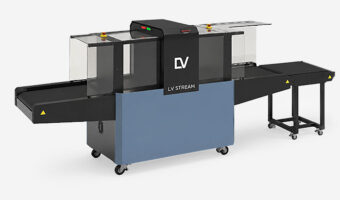


A-EYE–powered dual-view X-ray bag screening for fast, seamless flow at high-traffic venues and schools.
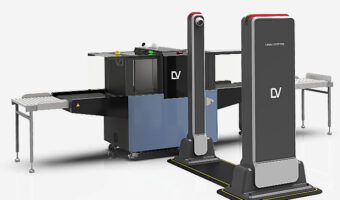
A-EYE–powered checkpoint combining people screening and LV STREAM baggage screening in one coordinated flow.
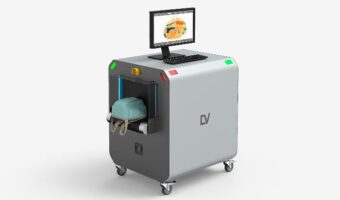
Small parcels and baggage inspection · AI-powered threat detection · Remote monitoring
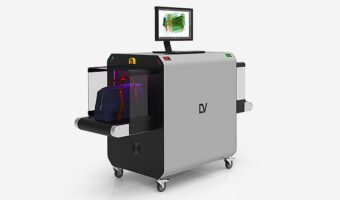
Small baggage inspection · AI-powered threat detection · Remote monitoring
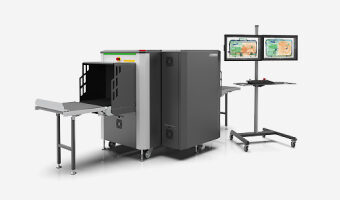
Small and medium sized baggage inspection · Improved detection by Dual View · AI-powered threat detection · Remote monitoring
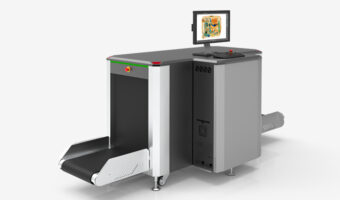
Medium sized check-in baggage inspection · AI-powered threat detection · Remote monitoring
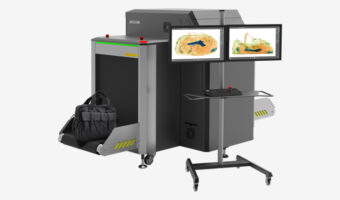
Mid-sized baggage inspection · Improved detection by Dual View · AI-powered threat detection · Remote monitoring
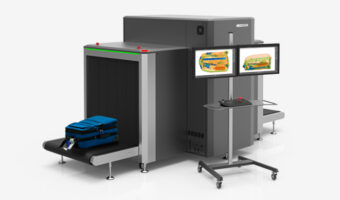
Large baggage and small cargo inspection · Improved detection by Dual View · AI-powered threat detection · Remote monitoring
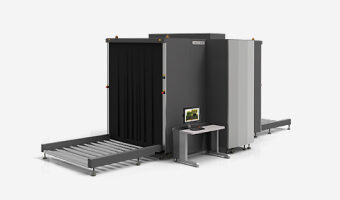
Heavy baggage, large packages and mid-sized cargo inspection · AI-powered threat detection · Remote monitoring
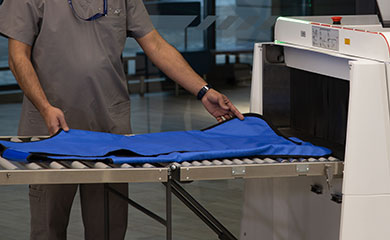
Tunnel-type cabinet scanners are the workhorse of checkpoint screening at airports, stadium gates, government buildings, courthouses, and mailrooms. Bags and parcels move through the tunnel on a conveyor and are imaged in seconds. Dual-view systems, which image each item from two angles, reduce the chance that a threat is hidden behind another object and make it easier to judge the shape of suspicious items.
For WMD screening, the priorities are fine wire resolution to reveal initiators and circuitry, strong steel penetration to see inside dense items, reliable material discrimination, and ATD to flag anomalies at high throughput. In the US, technical performance of checkpoint cabinet systems is benchmarked against ANSI N42.44, and radiation safety for cabinet X-ray systems is governed by FDA rule 21 CFR 1020.40.
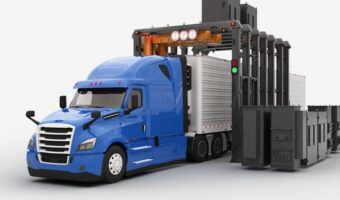
Multi Energy X-ray Portal | AI-powered cargo and vehicle screening system with Multi-Energy Array technology built for high-throughput, precision, and future-ready security
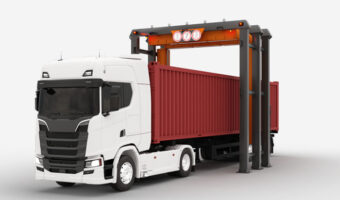
AI-powered 3D cargo and vehicle inspection system with Multi-Energy Array technology and spectral tomography
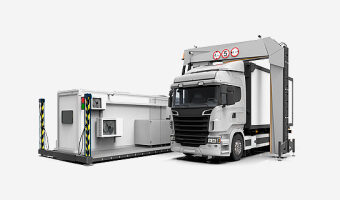
A combination of cost effective DTP 7500LV solution and unique hydraulic relocation set making it possible to deploy high-throughput cargo and vehicle screening checkpoint within just 1 hour
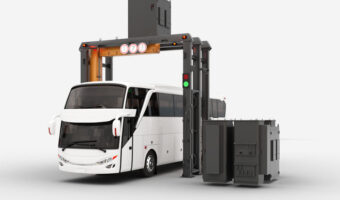
Dual-view screening solution for threat and contraband detection in buses in drive-through mode at speeds up to 15km/h
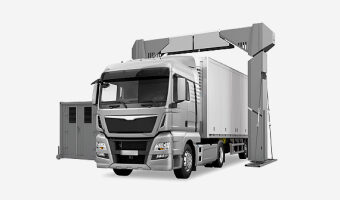
The lowest dose to vehicle drivers than competing systems; high-throughput cargo and vehicle screening with steel penetration of not less 320 mm for threat and contraband detection; small exclusion zone and operation footprint; easy-to-use operator controls and image analysis software
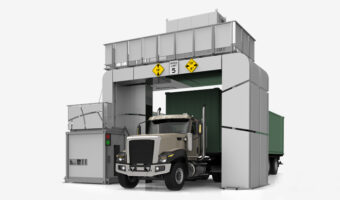
The system’s unique multiple projection and energy technology makes it possible to provide safe inspection of multi size vehicles like passenger vehicles, vans, buses and loaded trucks at the same time.
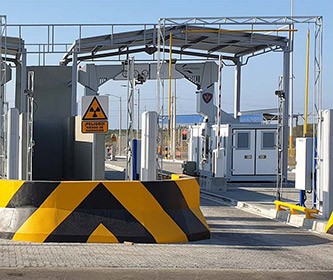
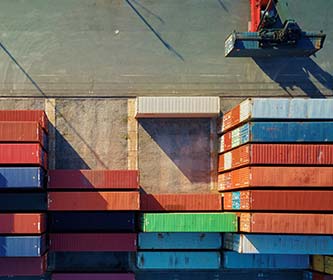
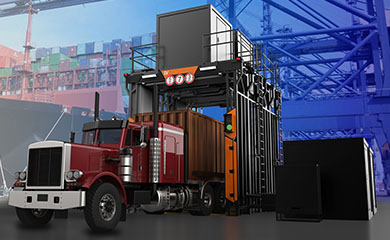
Shipping containers, trucks, and passenger vehicles are the most likely path for moving larger quantities of WMD material, and they offer far more concealment space than a bag. High-energy cargo and vehicle inspection systems image an entire conveyance, including full 40-foot ISO containers, in a single pass, revealing dense shielded objects, anomalies against the manifest, and modifications to the vehicle structure. The relevant US performance standard, ANSI N42.46, covers systems that inspect vehicles of any type, marine and air cargo containers of any size, railcars, and palletized cargo.
These systems come in fixed, relocatable, and mobile formats. Fixed portals suit ports of entry and logistics hubs with constant volume. Mobile inspection points, mounted on trucks or trailers, can be deployed to temporary checkpoints, major events, or facilities that need vehicle screening without permanent construction. For the same reason, they are a common choice of X-ray defense equipment at forward and temporary military positions.
Automatic detection is especially valuable in cargo screening, because a full container image contains far more information than an operator can review in detail at port throughput. In LINEV Systems cargo and vehicle inspection, AI works at the raw data level rather than on a finished image. The Multi-Energy X-ray Array (MEA) technology fuses multi-energy and dual-view signals before the image is reconstructed, so the detection engine can classify materials, separate objects that look alike in a conventional 2D projection, and assign risk scores in real time. In its most advanced configuration, the system builds a three-dimensional model of the cargo interior and analyzes material composition across the entire load. Operators receive prioritized alerts instead of raw imagery to evaluate from scratch, which lowers false alarm rates, speeds clearance of low-risk cargo, and keeps detection performance stable over long shifts. For WMD screening, this matters most where shielding or a dispersal device is buried inside a dense, mixed load that a flat projection would render as clutter.
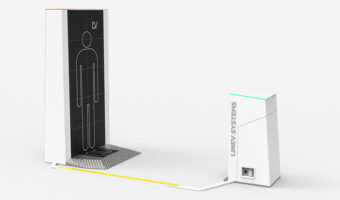
AI-assisted X-ray body screening system with sub-second scan time, ultra-low dose, and localized visual evidence
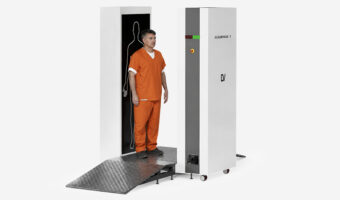
Compact, movable X-ray body screening engineered for the smallest practical footprint in correctional security. AI-assisted visual evidence, and fast operator-confirmed decisions
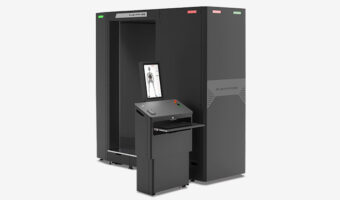
General-use full-body screening technology with extremely low x-ray dose rates to screen a person and which can be used for any applications
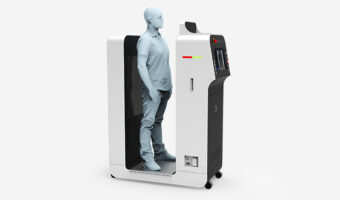
A portable addition to stationary systems, requiring minimal space and ready for immediate use, facilitating fast and on-demand prisoner screening
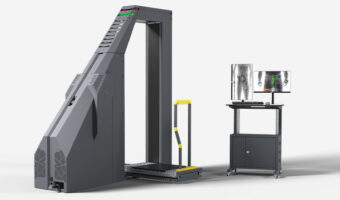
Dual-view screening technology (full-body and torso images) at two x-ray doses is best suited for detecting drugs and contraband, as it allows screening of staff, prisoners, and visitors where required

Partial screening technology delivers high-resolution torso images, providing an effective solution for detecting drugs and contraband inside individuals' bodies, whether in a prison setting or other non-prison environments.
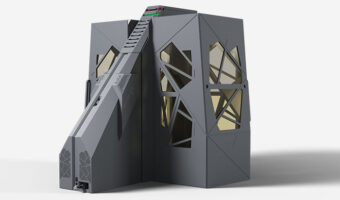

The X-ray shielding cabin is a high-protective option for full body scanner designed for maximum X-ray safety
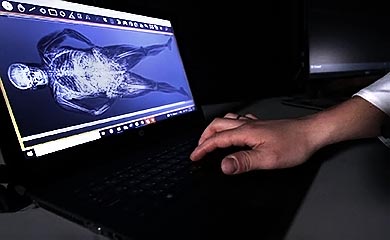
People can carry threat components on or inside the body, including body-borne improvised explosive devices. Millimeter-wave and backscatter systems were designed to find objects under clothing; transmission X-ray body scanners image through the body and can reveal objects that are concealed on or inside it. The US imaging performance standard ANSI N42.47 applies to systems that detect objects carried on or within the body, and radiation safety for personnel screening is addressed by ANSI/HPS N43.17, which sets dose limits per scan and per year.
Body scan images are harder to interpret than baggage images because of the complex anatomical background, which makes AI assistance particularly valuable. LINEV Systems body scanners are supported by two assistance tools: DruGuard, a patented algorithm that detects narcotics concealed inside the body, and a threat detection algorithm that automatically finds objects on or in the body and color-codes them into four groups: electronics, clothing and accessories, foreign objects, and threats or weapons. For WMD screening, automatic flagging of weapons and foreign objects shortens decision time and reduces dependence on individual operator experience.
Deployment by Facility Type
The right mix of systems depends on what moves through the facility, how fast it must move, and what the consequences of an attack would be.
Airports and Air Cargo
Airports screen passengers, carry-on and checked baggage, staff, and air cargo, and each stream is a potential pathway. Checkpoint baggage scanners and body scanners handle people and their belongings, while palletized air cargo and delivery vehicles at airside perimeters call for larger systems. Air cargo deserves particular attention because it moves in volume and often receives less public scrutiny than passenger screening.
Stadiums, Arenas, and Event Venues
Venues face extreme peak loads: tens of thousands of people arriving in a short window. Professional leagues have shifted toward clear-bag policies, walk-through metal detection, and X-ray screening of permitted bags and deliveries. For WMD risk, the most important additions are vehicle and delivery screening at loading docks, where large quantities of material can enter unseen, and mobile inspection points that can be deployed for major events and removed afterward.
Seaports and Land Borders
Ports of entry are where Resolution 1540 obligations become operational. High-energy container and vehicle scanning, combined with radiation portal monitors, is the established model. Free trade zones and transshipment hubs carry elevated risk because cargo may pass through with limited documentation.
Government Buildings and Critical Infrastructure
Federal and state buildings, courthouses, power plants, water treatment facilities, and transportation hubs typically combine checkpoint baggage scanning for visitors with vehicle screening at controlled access points. For critical infrastructure, the screening goal includes preventing contamination of systems that serve large populations, not only protecting the people on site.
Military Installations
Permanent and temporary military bases are logistics nodes for supply, medical support, and operations, which makes them high-value targets for both conventional and asymmetric attacks. Naval dockyards and ports must screen vessels’ cargo and approaching traffic, and military air bases that deploy troops and materiel must screen everything moving through them. Defense equipment X-ray requirements in this sector emphasize ruggedness, rapid deployment, and the ability to screen vehicles and cargo at the gate. Mobile and relocatable systems are often preferred for forward or temporary bases where fixed construction is impractical.
Post-Incident Value of Scan Data
Screening systems also serve after the fact. Archived, time-stamped images record what passed through each checkpoint, which supports investigators in reconstructing events, identifying the individuals or groups responsible, and tracing how materials entered a facility. Detailed scans can also give first responders information about a device’s construction before they approach it. To be useful, archives need defined retention periods, secure storage, access controls, and an export path in a standard format that investigators can use.
Why LINEV Systems
LINEV Systems designs and manufactures X-ray inspection technology for people, baggage, parcels, cargo, and vehicles, which allows a single supplier to cover every screening layer described above.
AI-Assisted Detection Across Screening Layers
AI is built into the core of LINEV Systems screening. On body scanners, DruGuard detects internally concealed narcotics, and the threat detection algorithm automatically identifies and categorizes objects on or in the body, so operators see flagged threats immediately rather than searching every image manually. In cargo and vehicle inspection, Multi-Energy X-ray Array (MEA) technology applies AI to raw multi-energy, dual-view data before image reconstruction, classifying materials and scoring risk across the full load in real time. The result is faster decisions, fewer false alarms, and more consistent performance across operators and shifts.
Pioneering Transmission Body Screening
LINEV Systems was the first company to propose, patent, and commercialize transmission X-ray technology for human screening, the approach that makes it possible to detect objects concealed inside the body, not only under clothing.
Coverage From Checkpoint to Container
The product range spans tunnel baggage scanners, full and partial body scanners, cargo and vehicle inspection systems, and mobile inspection points. Facilities can build a consistent, integrated screening architecture rather than combining equipment from several vendors with different interfaces and data formats.
Built for Demanding Environments
Systems are engineered for continuous operation in correctional, border, military, and transportation settings, and are designed to integrate with existing access control and security systems as part of a layered approach.
Support Throughout the Lifecycle
LINEV Systems provides 24/7 support, remote diagnostics, and comprehensive maintenance, along with operator training and ongoing consultation, so detection performance holds up as threats and operating conditions change.
LINEV Systems Track Record and Credentials
LINEV Systems has specialized in high-performance X-ray inspection since 2006 and operates its US business from Conroe, Texas. The company has deployed more than 1,000 transmission X-ray body scanners across 42 states. Its partial body scanning solution received the 2023 Platinum ASTORS Homeland Security Award for Best Contraband Detection Solution from American Security Today. Customers include large public agencies such as the Maricopa County Sheriff’s Office, which selected LINEV Systems after a competitive evaluation to equip six buildings with body scanners.
Sources
- European Commission. “Protection of Public Spaces”.
- United Nations Security Council. “Resolution 1540 (2004)”.
- U.S. Customs and Border Protection. “Non-Intrusive Inspection Systems & Radiation Detection Equipment: Fiscal Year 2015 Accomplishments”.
- Global Affairs Canada. “Evaluation of the Weapons Threat Reduction Program (WTRP), 2018-19 to 2023-24”.
- National Institute of Standards and Technology. “Standards for X-Ray Inspection Systems”.