















Table of contents
- Growing Demand for Container and Vehicle X-Ray Inspection
- For What Types of Large and Oversized Vehicles Can X-Ray Scanners Be Used?
- What Can an X-Ray Container Scanner Detect?
- Where Container, Van and Truck X-Ray Scanners Are Used?
- Managing Peak Traffic and Queue Flow
- Treat the Queue as a Controlled Buffer, Not a Side Effect
- Staff to the Actual Bottleneck, Then Rotate to Protect Decision Quality
- Keep Decisions Fast by Making Them Repeatable
- Measure the Peak, Not the Day
- X-Ray Inspection Solutions for Vans, Containers and Trucks
- AI and Multi-Energy Detection Technology
- Benefits of X-Ray Machines for Van and Container Inspection
- Engineering and Deployment Behind LINEV Systems Equipment
- How to Choose X-Ray Scanning Machines for Container, Van and Other Shipments
- FAQ about X-ray Inspection Systems for Container, Van and Truck
X-Ray Security Scanners for Vans, Containers and Trucks
FOCUS: Detecting weapons, explosives, drugs, and hidden compartments inside loaded vans, trucks, and containers without unloading cargo
APPLICATION: Drive-through screening of vans, trucks, and containers at border crossings, ports, and inland checkpoints
SOLUTION: AI-powered X-ray scanners for containers, vans, and trucks
X-ray machines for vans and containers scanning are used in a variety of locations, including ports, border crossings and transportation hubs. They are commonly used by customs officials, border control agencies, and law enforcement agencies to inspect containers, vans, lorries, and other shipments.
These scanners are also used by shipping and logistics companies to ensure the safety and security of their cargo and to comply with regulatory requirements. Additionally, some private companies and organizations may use these scanners to inspect their own van, lorrie, container and other shipments for security purposes.
The volume behind this screening effort is substantial. According to the U.S. Department of Homeland Security, on a typical day CBP inspects and clears more than 91,000 truck, rail, and sea containers and over 10,500 shipments of goods, collecting more than $306 million in duty, taxes, and fees1. Within that volume, enforcement data shows the scale of what non-intrusive inspection is up against: CBP reporting indicates that more than 85 percent of illegal drug seizures, excluding marijuana, occur at official ports of entry — the checkpoints where vehicles and cargo undergo inspection — rather than in the areas between crossings2. In fiscal year 2024 alone, CBP seized more than 19,600 pounds of fentanyl through the end of August, a record for the agency3. These figures illustrate why high-throughput, non-intrusive X-ray inspection has become a baseline requirement rather than an optional upgrade at any facility processing meaningful vehicle or cargo volume.
Growing Demand for Container and Vehicle X-Ray Inspection
Global container trade set new volume records through 2025, with world container port throughput growing well above its decade-long average annual rate4. Rising trade volumes, combined with tightening customs enforcement and counter-narcotics programs at land borders, are increasing pressure on ports, border crossings, and inland terminals to inspect more vehicles and containers without slowing legitimate trade. This is the core driver behind sustained investment in non-intrusive container and vehicle X-ray inspection capacity across both government agencies and private logistics operators, and it explains why throughput and detection accuracy — not just detection capability on paper — have become the defining factors when evaluating a new system.
For What Types of Large and Oversized Vehicles Can X-Ray Scanners Be Used?
X-ray scanning machines of cargo are designed to scan a variety of large vehicles, including vans, buses, trains, lorries and containers.
These systems are typically equipped with a large tunnel or scanning area that can accommodate vehicles of various sizes and shapes. Some X-ray scanning machines can even scan multiple vans, lorries or containers at once, making them ideal for use in high-traffic areas such as border crossings, ports, and airports.
Container X-ray scanners use advanced imaging technology to provide high-resolution images of contents, allowing security personnel to quickly and accurately identify any potential security threats.
What Can an X-Ray Container Scanner Detect?
X-ray scanners for container and van inspection can detect a wide range of threats, objects and materials, including weapons, explosives, drugs, contraband goods and people smuggling. They can also help to identify anomalies in the vans, lorries and containers that may indicate tampering or hidden compartments.
As inspection technology evolves, automated analysis is playing a growing role in how consistently these threats get identified across high-volume checkpoints — see our overview of AI-powered logistics security systems for weapon detection and smuggling prevention for a closer look at how this shift is unfolding across the industry.
Where Container, Van and Truck X-Ray Scanners Are Used?
Container and vehicle X-ray inspection is not confined to a single type of facility. The configuration, throughput, and detection priorities vary considerably depending on where the system is deployed.
Border Crossings and Land Customs Checkpoints
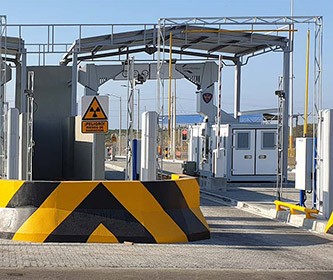
This is the most demanding environment for cargo screening, combining high vehicle volume, mixed traffic — passenger cars, vans, buses, and loaded trucks passing through the same lane — and strict time pressure to avoid backups at the crossing point. Systems here need to handle a wide range of vehicle types without switching configurations between them.
Seaports and Container Terminals
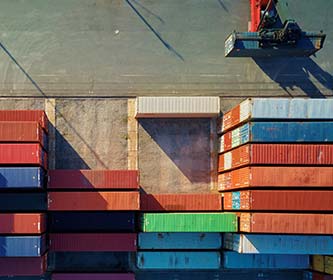
Inspection at ports focuses on shipping containers and loaded trailers rather than mixed passenger traffic. Throughput requirements are still high, but the priority shifts toward penetrating dense, fully loaded cargo and verifying manifests against actual contents, often as part of a broader customs risk-targeting program.
Military Bases and Government Facilities
Screening here is less about traffic volume and more about consistent, high-assurance inspection of every vehicle entering a secured perimeter, frequently paired with under-vehicle inspection and license plate recognition to maintain a full record of site access.
Logistics Hubs, Free Trade Zones and Distribution Centers
Private logistics operators use cargo scanning both to meet regulatory requirements and to protect their own supply chain from internal theft, tampering, or unauthorized cargo. Detection needs resemble a border environment, but the operator is typically the company itself rather than a government agency.
Rail Terminals
Inspecting loaded railway carriages presents a different challenge: cargo cannot be unloaded for inspection without significant cost and delay, so screening has to happen while carriages remain coupled and, ideally, while the train is still moving through the checkpoint at a controlled speed.
Each of these environments places a different weight on throughput, penetration depth, and vehicle mix — which is why cargo X-ray systems are typically selected and configured around the specific site rather than treated as a single generic product.
Managing Peak Traffic and Queue Flow
Scanner throughput is only one part of the equation. In practice, the single biggest determinant of whether a port, border crossing, or inland hub keeps freight moving during peak arrivals is not how fast the machine scans — it’s how well the surrounding operating model handles the surge.
Peak congestion follows a chain: vehicles arrive, get positioned, get scanned, get reviewed, and either clear or get diverted to secondary inspection. A queue can form at any link in that chain, and each bottleneck calls for a different fix. If the scan lane itself is the constraint, the answer is lane readiness and eliminating non-productive gaps between vehicles. If image review is the constraint, the answer is staffing and clearer escalation rules. If secondary inspection is the constraint, a strong primary screening program will simply create gridlock downstream unless targeting and staging are rebalanced. Treating the process as a chain, rather than optimizing the scanner in isolation, is what separates sites that handle peak volume smoothly from those that don’t.
Treat the Queue as a Controlled Buffer, Not a Side Effect
A queue that’s too short leaves the scan lane starved between vehicles; a queue that’s too long risks spilling back into public roadways and pressures officers into rushed decisions. The practical fix is usually structural rather than technological:
- A staging area to absorb surges without spillback into live roads;
- A marshaling point that assigns lanes and resolves conflicts before vehicles reach the scanner;
- A defined commit point where a vehicle formally enters the scanning process and is no longer swapped in and out;
- Standardized lane-change rules to reduce last-minute merges and stop-start motion;
- A protected secondary access path so diverted vehicles don’t block the primary lane.
These controls remove the kind of stop-start motion that quietly erodes vehicles-per-hour far more than most teams expect.
Staff to the Actual Bottleneck, Then Rotate to Protect Decision Quality
A schedule built around total headcount, rather than the real chain of tasks — traffic direction, lane positioning, scanning, image review, and the secondary handoff — tends to fail exactly when volume spikes. The more effective approach organizes the team around workflow, with backup staff deployed specifically where the constraint is occurring during that hour, rather than spread evenly across the shift.
Image review deserves particular attention: it is almost always the true limiting factor, not the scanner’s raw speed. Fatigue at the review station shows up directly as slower decisions and unnecessary diversions to secondary. Shorter rotations, clear escalation rules, and shift overlaps timed to known surge windows typically resolve this without adding headcount.
Keep Decisions Fast by Making Them Repeatable
Speed that comes at the cost of detection quality doesn’t eliminate risk — it relocates it downstream. Operations that hold up best under peak load standardize outcomes ahead of time: defined categories for routine clearances, clear triggers for escalation, and pre-assigned diversion destinations, so officers aren’t improvising process under time pressure. This only works if the operating concept and the technology are aligned — a fast scan lane feeding into an unprepared review station or an undefined diversion route simply moves the queue rather than resolving it.
Measure the Peak, Not the Day
Daily totals routinely mask the specific failures that occur during surge windows. Tracking the following metrics hourly, rather than by shift, usually reveals more than tracking daily totals ever will:
- Average gap time between vehicles in the lane;
- Real-time lane utilization;
- Average image review duration;
- Percentage of loads diverted to secondary;
- Clearance time for secondary bays.
In most cases, this level of detail shows that staffing patterns and shift structure affect throughput more than the arrival rate of freight itself. Handled this way, peak arrivals stop being a recurring crisis and become a predictable, measurable operating window — one that supports both rapid trade facilitation and rigorous enforcement outcomes at the same time.
X-Ray Inspection Solutions for Vans, Containers and Trucks
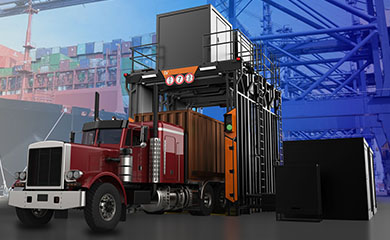
LINEV Systems offers a range of drive-through X-ray inspection portals for vans, containers, trucks, and rail, covering everything from standard border-crossing checkpoints to specialized screening scenarios. The lineup includes high-throughput portals for mixed traffic of cars, vans, buses, and loaded trucks; relocatable systems that can be deployed at a temporary or backup checkpoint within an hour; dedicated solutions for screening occupied passenger vehicles and buses without requiring passengers to exit; and a rail-specific system for inspecting train carriages without unloading cargo.
The table below gives a quick overview of how the main product lines differ. Full specifications, throughput figures, and configuration options are available on each product page.
| Product Line | Best For | Vehicle Types | Key Differentiator |
| MEAP Series | High-traffic border, port and passenger-vehicle checkpoints | Cars, vans, buses, trucks | AI-driven, multi-energy, modular — from occupied-vehicle screening to advanced spectral material analysis |
| DTP Series | Standard, high-volume and temporary checkpoints | Trucks, containers, mixed traffic | Ranges from cost-effective and relocatable configurations to high-throughput multi-energy portals |
| TRAINSCAN | Rail terminals and freight corridors | Railway carriages | Scans moving trains without uncoupling or unloading cargo |
Explore the full range below to find the configuration that fits your site’s traffic mix, throughput requirements, and deployment constraints.
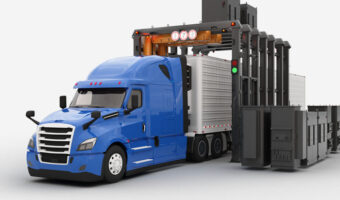

Multi Energy X-ray Portal | AI-powered cargo and vehicle screening system with Multi-Energy Array technology built for high-throughput, precision, and future-ready security
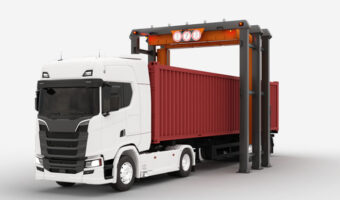
AI-powered 3D cargo and vehicle inspection system with Multi-Energy Array technology and spectral tomography
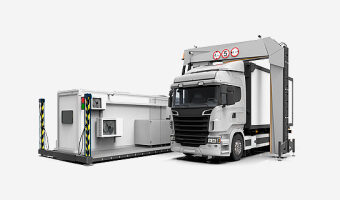
A combination of cost effective DTP 7500LV solution and unique hydraulic relocation set making it possible to deploy high-throughput cargo and vehicle screening checkpoint within just 1 hour
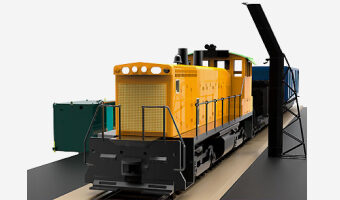

Inspection complex designed for non-intrusive X-ray screening of railway carriages
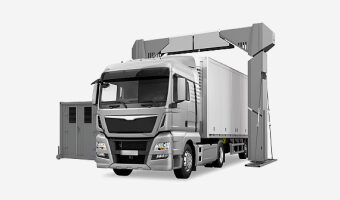
The lowest dose to vehicle drivers than competing systems; high-throughput cargo and vehicle screening with steel penetration of not less 320 mm for threat and contraband detection; small exclusion zone and operation footprint; easy-to-use operator controls and image analysis software
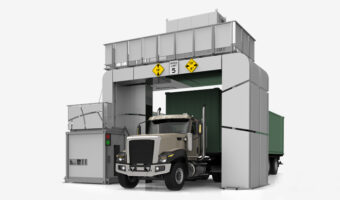
The system’s unique multiple projection and energy technology makes it possible to provide safe inspection of multi size vehicles like passenger vehicles, vans, buses and loaded trucks at the same time.
AI and Multi-Energy Detection Technology
The core value of a modern cargo X-ray system is not the image it produces, but how reliably that image gets turned into a decision. Two technology layers determine this: how the system captures the image, and how it interprets what’s inside it — and both are built into the product lines above.
Multi-Energy Imaging
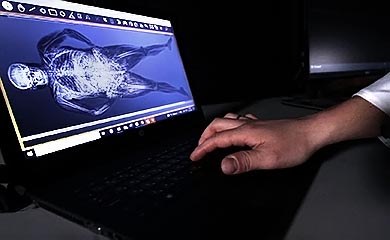
Older single-energy X-ray systems produce one grayscale image based on how much radiation passes through an object, and dense or light materials can look deceptively similar, leaving operators to interpret shading manually. Multi-energy systems pass X-rays at two or more distinct energy levels through the same cargo. Because organic materials, inorganic materials, and metals absorb radiation differently depending on the energy level used, comparing the resulting images allows the system to separate these material classes and assign each a distinct color in the output. This is the difference between seeing a shape that might be something and seeing an object with the density and composition profile of a specific material class — a meaningfully more actionable result for the officer making the call.
Dual-View and Multi-Projection Imaging
A single X-ray projection, no matter how sharp, still has blind spots. An object positioned directly behind another dense item in the same line of sight can be partially or fully obscured. Capturing the vehicle or container from two angles simultaneously — typically a side and an upper or angled projection — removes most of these blind zones and gives the reviewing officer a second reference view to confirm what a suspicious area actually is. For loaded trucks and containers with irregular cargo arrangements, this materially reduces both missed detections and false positives caused by overlapping shapes.
AI-Assisted Image Analysis
Multi-energy and dual-view imaging generate more data per scan, and this is where automated analysis earns its place. Rather than relying solely on the operator to manually read every color-coded region, AI-driven classification flags anomalies, applies consistent material discrimination rules across every scan, and highlights regions that warrant closer review before the officer even opens the image. The practical effect for a screening operation is threefold: faster time-to-decision per vehicle, more consistent outcomes across different operators and shifts, and a meaningful reduction in false alarms that would otherwise route legitimate cargo into secondary inspection unnecessarily.
None of these technologies functions well in isolation. A high-resolution single-energy image without material discrimination still leaves the interpretation entirely to the operator. Multi-energy imaging without a second projection angle still leaves blind spots. Rich, multi-angle, multi-energy data without automated analysis simply shifts the bottleneck from the scanner to the review station. Systems that combine all three layers keep speed at the lane from coming at the cost of interpretation quality downstream.
Benefits of X-Ray Machines for Van and Container Inspection
Increased security — X-ray scanners for vans, lorries, containers and goods inspection are essential for maintaining high levels of security at any checkpoint or facility perimeter.
Fast and efficient screening — Scanning is significantly faster than manual inspection, which matters most at high-traffic locations where delays disrupt both commercial and public traffic.
Non-invasive inspection — No physical unloading is required, reducing the risk of damage to goods and keeping the process safe for cargo, drivers, and — where occupied-vehicle screening is used — passengers as well.
Detailed, multi-angle imaging — Multi-energy imaging combined with dual-view projections produces material-differentiated images with fewer blind spots and fewer false alarms than single-angle, single-energy systems.
Lower long-term cost — Minimal maintenance requirements and small operating teams reduce the cost of inspection over the system’s lifetime compared to manual search.
Fits into existing security infrastructure — LINEV Systems equipment is designed to integrate into a facility’s existing security setup rather than operate as an isolated station. Scanners can be paired with license plate recognition, under-vehicle inspection systems, radiation portal monitors, and access control, and can feed image and event data into a site’s existing command and control or video management systems — turning a new scanning lane into part of a unified security operation rather than a standalone checkpoint with its own separate workflow.
Engineering and Deployment Behind LINEV Systems Equipment
The benefits above depend on the equipment being engineered to a consistent standard across every deployment, which is where the manufacturer behind the system matters. LINEV Systems designs and manufactures its X-ray inspection portals to meet international radiation safety and imaging standards, with systems approved for use across markets including the United States, United Kingdom, and United Arab Emirates. This regulatory groundwork is what allows a single product line to move between a land border crossing, a seaport terminal, and a government facility without a redesign for each site. Beyond the hardware itself, deployments are supported by dedicated training, technical assistance, and maintenance services throughout the system’s operational life — a factor worth weighing as heavily as imaging performance, since a scanner’s real-world reliability depends as much on the support behind it as on its specifications on paper.
How to Choose X-Ray Scanning Machines for Container, Van and Other Shipments
When choosing X-ray machines for van and container inspection systems, there are several factors to consider:
- Size and capacity. Ensure the scanner can accommodate the vans, lorries and containers you need to inspect.
- Imaging quality. Look for multi-energy, dual-view imaging, which provides more reliable material discrimination and fewer blind spots than single-energy, single-projection systems, particularly for densely loaded trucks and containers.
- Speed and efficiency. Choose scanners able to handle multiple containers or a mix of vehicle types with minimal wait time during peak traffic.
- Mobility and deployment flexibility. Not every checkpoint is permanent. Relocatable systems that deploy within an hour are worth considering for temporary checkpoints, seasonal surges, or as a backup during maintenance or breakdown of a stationary scanner, without sacrificing throughput or detection capability.
- Ease of use. Look for scanners with minimal service downtime, user-friendly interfaces, and minimal training required, ideally supported by AI-assisted image analysis that reduces the burden on the reviewing officer rather than adding another manual step.
- Compliance. Confirm the scanner complies with relevant industry standards and regulations, such as ANSI N42.46, IEC 62523 and FANR.
- Radiation safety. Choose scanners that are safe for human health, with minimal radiation impact, complying with ICRP guidelines, ANSI N43.17 and ANSI N43.3. For checkpoints screening occupied vehicles, confirm the system is specifically designed to keep dose levels safe for occupants, not just for operators.
- Cost. Consider total cost of ownership, including maintenance, repairs, and upgrades over the system’s lifetime.
- Support and service. Choose a supplier offering reliable training, technical assistance, and maintenance services.
Our engineering team can review your site’s traffic patterns and compliance requirements to help match them to the right configuration.
Yes, for systems specifically designed for occupied-vehicle screening. These solutions keep radiation dose to occupants within strict safety limits, allowing buses and passenger cars to be scanned without unloading passengers — which significantly improves throughput at checkpoints handling public transport or commuter traffic. Not every cargo X-ray system is rated for this; it’s a distinct capability worth confirming before deployment.
A single-energy system produces one grayscale image, leaving material identification largely to the operator’s interpretation of shading and shape. A multi-energy system captures the same object at two or more energy levels and compares the results, distinguishing organic materials, inorganic materials, and metals and assigning each a distinct color automatically. In practice, the officer reviewing the image is working from a system that has already done a first pass of material classification, rather than starting from a blank grayscale image.
This depends on the system and vehicle mix, but modern drive-through portals are built to keep vehicles moving at controlled speeds rather than requiring a full stop, with throughput scaled to the checkpoint’s traffic profile. Actual peak performance, however, depends as much on lane operations, staffing, and review workflow as on the scanner’s rated speed — a system’s maximum throughput figure is a ceiling, not a guarantee, unless the surrounding process is set up to support it.
Yes. Relocatable systems can be deployed to a new checkpoint location in about an hour, without requiring crane assistance, and can run on an independent power supply. These are commonly used for temporary or seasonal checkpoints, or as a backup while a stationary scanner is undergoing maintenance or repair.
At minimum, confirm compliance with recognized imaging and safety standards such as ANSI N42.46 and IEC 62523, along with radiation safety standards including ICRP guidelines, ANSI N43.17, and ANSI N43.3. For public-sector or cross-border procurement, these certifications are typically required for regulatory approval and for the system to be accepted in a formal tender process — confirming them early avoids delays later in procurement.
A container scanning machine is a portal-based, drive-through X-ray system built specifically to inspect containers, trucks, and vans as complete units, without unloading them — the type of equipment covered throughout this guide. General cargo scanning equipment, by contrast, is typically designed for palletized freight, break-bulk shipments, or unitized cargo handled outside a vehicle, and often uses a different scanning geometry suited to that format. If you’re inspecting loaded containers, trailers, or vehicles as a whole, a portal-based container scanning machine is the right category; for palletized or break-bulk freight screening, see our cargo and vehicle X-ray machine range instead.
Source
1. U.S. Department of Homeland Security. “Border Security“.
2. Washington Office on Latin America (WOLA). Analysis of U.S. Customs and Border Protection FY2025 drug seizure data. Source.
3. U.S. Customs and Border Protection. “Frontline Against Fentanyl“.
4. UN Trade and Development (UNCTAD). Container port throughput data.