











Table of contents
Inline Baggage Screening Systems
FOCUS: Inline screening of bags, parcels, and mail on a moving conveyor, with AI primary screening, tiered alarm resolution, and throughput sizing for peak demand
APPLICATION: Event venues, schools, government buildings, courthouses, mail centers, correctional facilities, logistics operations, and ground transport terminals
SOLUTION: Baggage X-ray security solutions with AI
An inline baggage screening system is an X-ray inspection unit that works as one step in a continuous flow rather than as a standalone station. Items enter on an infeed conveyor and pass through the inspection tunnel. They then exit onto a conveyor or collection point where they are either released or held for a closer look. The decision is made while the flow keeps moving.
In a standalone setup, by contrast, the scanner is an island. Someone loads each item, an operator studies the image, and someone unloads it. Throughput is capped by how fast people can lift, look, and lift again. Inline screening changes the governing constraint from human handling to conveyor speed, item spacing, and decision logic. That is why it scales to peak volumes that standalone stations cannot absorb.
The architecture first matured in large baggage handling operations, where items are screened on the move behind the scenes. This guide focuses on the security applications where inline screening is now spreading fastest: public entrances, mail and parcel streams, correctional facilities, logistics, and ground transport.
How Inline Screening Works
Most inline baggage screening systems follow a three-tier decision model.
Tier 1: automated primary screening. The item passes through the tunnel and is imaged. AI-based detection software analyzes the image and assigns a clear or alert result. Depending on site policy, clear items move on without an operator viewing every image.
Tier 2: operator review. Alerted images go to an operator, who confirms or dismisses the alert using image enhancement tools. The item keeps moving during this review. The time it takes to travel from the tunnel exit to the decision point defines the operator’s decision window.
Tier 3: physical resolution. Items that remain unresolved are set aside for a hand search, trace testing, or escalation under the site’s security procedures, and are then released or retained.
The proportion of items that reach Tier 2 and Tier 3 drives everything else in the design: staffing, the length of the decision zone, and the size of the inspection area. A school looking for weapons and vapes, a mailroom watching for suspicious packages, and a correctional facility focused on drugs and phones will each see very different alert profiles from the same hardware.
Where Inline Screening Is Used
Demand for inline screening outside aviation is driven by facilities that face real threats at volumes manual search cannot handle. In US public schools, the share of schools conducting daily metal detector checks on students rose from 0.9% in 1999–2000 to 2.7% in 2019–20 (NCES, 2022). Each of those checks creates a bag-screening workload at the same entrance. In the mail stream, postal inspectors responded to 2,555 incidents involving suspicious items, substances, powders, or liquids in the mail or at postal facilities in FY 2018 (USPIS, 2018). In corrections, the challenge is both detection and staff safety. An Oregon assistant inspector general estimated that mailroom workers catch only about half of the drugs entering prisons through the mail (Corrections1). In Minnesota, roughly two dozen corrections staff were medically treated in a single year because of drug exposure (KSTP, 2024).
Each scenario places different demands on the system. The table below matches typical inline screening scenarios to the equipment configuration that usually fits best.
| Scenario | What moves through the line | Peak pattern | Primary screening concerns | Configuration that typically fits |
| Stadiums, arenas, and event venues | Backpacks, handbags, small personal bags | Sharp ingress peak in the hour before an event | Firearms, knives, flares and pyrotechnics, improvised explosive devices | Dual-view bag lane with AI primary screening; a coordinated people-and-bag checkpoint at the highest-volume gates |
| K-12 schools and campuses | School bags, backpacks, sports bags | Short morning arrival window, plus after-hours events | Firearms, knives, vapes | Dual-view bag lane with AI primary screening, paired with walk-through metal detection |
| Government buildings and courthouses | Visitor bags and briefcases; separate incoming mail | Morning visitor peak; mail in daily batches | Weapons, explosive device components, suspicious mail | Mid-size tunnel scanner at the public entrance; compact tunnel scanner on a dedicated mailroom line |
| Corporate mail centers | Letters, flats, small parcels | Batch deliveries from carriers | Suspicious packages, explosive device components, concealed powders | Compact single-view tunnel scanner integrated with the sorting table or conveyor |
| Correctional facilities | Mail and packages, visitor belongings, inmate property | Visiting hours, intake, daily mail | Drugs, phones, blades, concealed compartments | Compact tunnel scanner for mail; mid-size dual-view scanner for visitor and property screening |
| Logistics and parcel handling | Mixed parcels and boxes | Shift-based sortation peaks | Weapons, contraband, undeclared dangerous goods | Large-aperture tunnel scanner sized to the largest regular item and integrated with the sorter |
| Rail, bus, ferry, and cruise terminals | Luggage and carry-on bags | Departure-linked waves | Weapons, explosive devices | Mid-size or large dual-view scanner at baggage drop; bag lane at passenger entry |
| Industrial and high-value retail sites | Employee bags at entry and exit | Shift changes | Theft of high-value goods outbound; prohibited items inbound | Compact tunnel scanner or bag lane at the staff entrance |
Two scenario-specific points are worth noting. First, in correctional mail screening, X-ray reliably reveals concealed objects, packaged substances, hidden compartments, and electronics. Drug-soaked paper, however, typically needs trace or chemical testing alongside imaging. A sound inline design routes alerted items to that testing step. It also reduces how often staff open unknown items by hand. Second, at venues, ingress design must account for re-entry and for items that will never fit a bag tunnel, such as strollers, mobility aids, and large equipment cases. These need a defined manual route so they do not stall the main lanes.
Technology Components That Determine Performance
Tunnel aperture. The opening should accommodate the largest item the line handles in normal operation, not the average one. An undersized tunnel pushes items onto manual handling and undermines the inline concept. Apertures in this equipment class range from about 500 × 300 mm for mail and personal bags to 1,600 × 1,800 mm and beyond for heavy baggage and mid-sized cargo.
Single view vs. dual view. A single-view scanner produces one projection of each item. A dual-view scanner uses two X-ray sources at different angles to produce two simultaneous views. This reduces the ambiguity caused by overlapping objects, unfavorable orientation, or deliberate concealment. In a moving flow, where re-scanning an item disrupts the line, dual view also gives detection software and operators more information on the first pass.
Image quality. Penetration, wire resolution, and color-coded material classification determine what software and operators can actually see. Buyers should ask for performance results against recognized independent test methods rather than relying on brochure figures.
Conveyor and control integration. The scanner must exchange signals with upstream and downstream equipment, such as start and stop, item present, and the decision result. Confirm the interface at the design stage. Discovering an incompatibility at commissioning is the most common cause of delays in inline projects.
Mobility. Fixed installations suit mailrooms and logistics lines. Venues and schools often benefit from mobile units that can be moved between entrances, stored between events, or relocated as site layouts change. Check whether a unit fits through standard doorways.
Throughput Planning and Sizing
A scanner’s belt speed is not its throughput. Realistic capacity depends on four variables.
Belt speed and item pitch. Tunnel X-ray conveyors typically run at around 0.2 m/s. Suppose an average bag plus the gap to the next one occupies 1 meter of belt. The theoretical maximum is then one bag every five seconds, or 720 bags per hour. Loading is never perfectly uniform, so planners typically apply a 70–80% utilization factor, which gives roughly 500–575 bags per hour per lane in this example. Peak-flow bag lanes designed for pedestrian entrances use continuous-flow loading to push well beyond conventional checkpoint rates.
Decision window. Divide the tracked distance between the tunnel exit and the decision point by the conveyor speed. If the result is shorter than typical operator review time, the line will stop for alerted items. Lengthen the decision zone, add buffer conveyors, or raise the share of items cleared automatically.
Alert rate. More alerts mean more Tier 2 reviews and more Tier 3 inspections. Size the inspection area for peak alert volume, not the daily average.
Peak profile. Venues are sized for the last hour before doors close, schools for the arrival window, and mailrooms for the busiest delivery batch. A line sized for average load fails at exactly the moment it matters most.
A practical method is to take the peak-hour item count, divide it by realistic per-lane throughput, and round up. Add one lane of redundancy wherever a single-unit outage would stop the operation.
Design and Integration Considerations
Radiation safety. In the US, X-ray baggage inspection systems fall under the federal performance standard for cabinet X-ray systems, 21 CFR 1020.40 (eCFR). It limits emitted radiation to 0.5 milliroentgen per hour at 5 cm from any external surface. Request the compliance documentation and check state registration requirements, which vary.
Space and routing. The footprint of an inline line is larger than the scanner itself. It includes infeed and outfeed conveyors, the decision zone, the inspection area, queuing space, and service clearance. In existing buildings, these elements constrain the layout more than the scanner does.
Staff safety in mail and property screening. Where unknown substances are a concern, place the inspection area so that alerted items can be isolated. Equip staff with the appropriate protective equipment and procedures.
IT and data. Screening images and event records need defined retention rules and access controls. Systems that operate on a local architecture without depending on an external network connection simplify approval at sites with strict IT policies.
Training. AI-assisted inline screening changes the operator’s task from reading every image to resolving alerts quickly and correctly. Training should reflect that shift, including decision practice under time pressure.
Inline Baggage Screening Solutions from LINEV Systems
LINEV Systems builds X-ray inspection equipment that covers both ends of the inline spectrum. At one end are peak-flow entrance solutions, where people and their bags must move without queuing. At the other is a tunnel scanner range for mail, property, baggage, and cargo flows.
Peak-Flow Bag Screening: LV STREAM
LV STREAM is the flagship for high-traffic entrances at venues, schools, and public buildings. Visitors place bags, backpacks, handbags, and school bags on a continuously moving conveyor. A-EYE™ then performs AI primary screening on dual-view X-ray data and issues a clear or alert result for each bag. Automatic alerts cover weapons, flares, vapes, fireworks, and potential improvised explosive devices.
Clear bags keep moving, and staff attention goes only to bags that need review, resolution, or secondary inspection. Trained personnel remain in control of alarm resolution and final response. Because the checkpoint no longer depends on continuous image interpretation, it needs fewer specialist image-reading skills, and training is simpler. The mobile configuration passes through standard doorways, so one unit can serve different indoor entrances as site needs change.
Coordinated People and Bag Screening: STREAMSYNC
A fast bag lane helps only if the people-screening side keeps pace. STREAMSYNC combines LV STREAM with compatible walk-through people screening in one coordinated checkpoint.
When a visitor places a bag on the conveyor and steps into the people-screening lane, both inspections start in parallel. LINEV checkpoint software keeps the person and the bag associated even though they follow separate physical paths at different speeds. The software also monitors baggage collection. VISUAL EVIDENCE™ shows the location of a people-screening alert on a digital silhouette of the actual person. On one tablet-based interface, the operator sees that location together with the linked baggage result and the collection status, instead of switching between separate detector, X-ray, and camera displays.
The checkpoint runs on a local architecture with no external WAN dependency for normal operation. It can be configured as a single lane or multiple lanes, sized to the entrance.
Tunnel Scanners for Mail, Property, Baggage, and Cargo Flows
Not every inline line is a pedestrian entrance. Mailrooms, correctional property and mail screening, transport baggage drops, and logistics lines call for tunnel scanners sized to the items they carry. The LINEV Systems baggage X-ray scanners range spans tunnel apertures from 500 × 300 mm to 1,600 × 1,800 mm. Single-view and dual-view configurations are available, and AI-powered threat detection and remote monitoring are supported across the range.
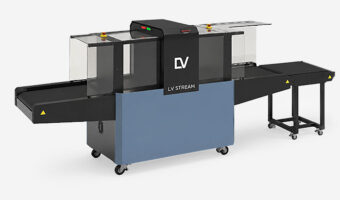


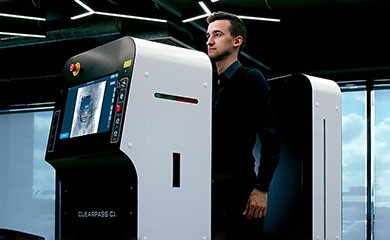
A-EYE–powered dual-view X-ray bag screening for fast, seamless flow at high-traffic venues and schools.
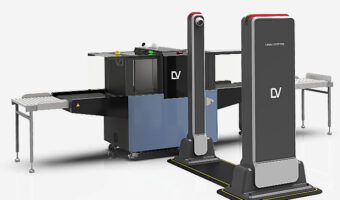
A-EYE–powered checkpoint combining people screening and LV STREAM baggage screening in one coordinated flow.
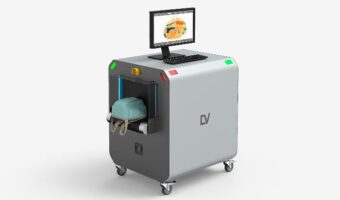
Small parcels and baggage inspection · AI-powered threat detection · Remote monitoring
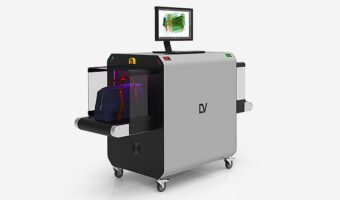
Small baggage inspection · AI-powered threat detection · Remote monitoring
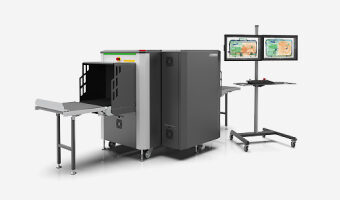
Small and medium sized baggage inspection · Improved detection by Dual View · AI-powered threat detection · Remote monitoring
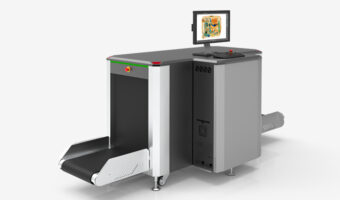
Medium sized check-in baggage inspection · AI-powered threat detection · Remote monitoring
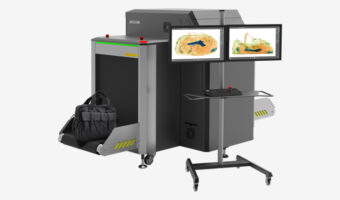
Mid-sized baggage inspection · Improved detection by Dual View · AI-powered threat detection · Remote monitoring
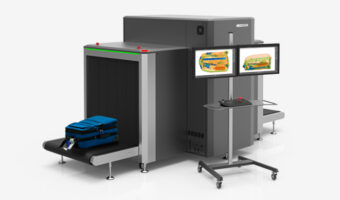
Large baggage and small cargo inspection · Improved detection by Dual View · AI-powered threat detection · Remote monitoring
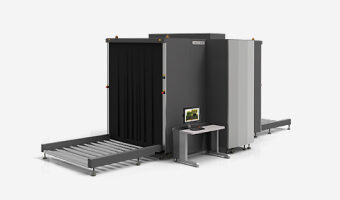
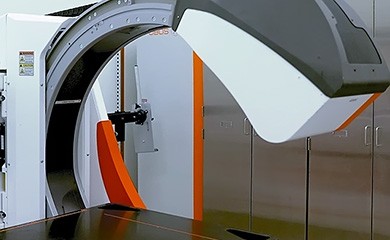
Heavy baggage, large packages and mid-sized cargo inspection · AI-powered threat detection · Remote monitoring
AI and Software for Inline Screening
In an inline line, software determines two things that hardware alone cannot: how many items clear without waiting for an operator, and how long the line stays in service. LINEV Systems addresses the first with AI threat detection and image enhancement built into its baggage scanners. It addresses the second with remote telemetry.
BV Threat Detection: Automatic Threat Recognition with A-EYE
BV Threat Detection is built on A-EYE, the proprietary AI developed by LINEV Systems for automatic identification of threat objects in X-ray images of baggage and cargo. The algorithm is embedded in the scanner rather than added as an external workstation, so detection runs on every image at conveyor speed.
A-EYE was trained on real threat objects of the kind expected at theme parks, concerts, sporting events, schools, and other sites with security checkpoints. It was also trained on the cluttered backgrounds of real baggage: densely packed items of varying density, in every bag type. The standard detection library covers seven categories:
- Firearms. Handguns, revolvers, shotguns, and submachine guns, both assembled and disassembled, including separate firearm components.
- Ammunition. Empty or loaded clips and magazines, and rounds of various calibers, whether carried singly or in bulk.
- Knives. Combination, paper, jack, Swiss army, kitchen, and polycarbonate knives, as well as multi-tools, recognized folded or unfolded.
- Brass knuckles. The most common forms, palm grips, and materials used for this type of impact weapon.
- Grenades. The most widespread types, including MK2, M26, M67, F1, RGD-5, and RG-42, as well as incendiary and riot-control grenades.
- Flares and pyrotechnics. Colored smoke devices, smoke balls, flares, and devices that produce fire or flashes, in a range of shapes and diameters.
- Vapes. E-cigarettes and vaping devices of various types, including those concealed among personal belongings.
Vape detection reflects a concern that schools increasingly raise alongside weapons. Automated identification lets campus security enforce vaping policies at the entrance without hand-searching every bag. It also reduces the load on staff and allows intervention before devices reach classrooms.
Each detected object is highlighted on screen with a colored box and a category label. Operators of any experience level see immediately what was found and where it is. For inline operation, the system can also stop the conveyor automatically when a threat is detected. A flagged bag then stays at the scanner until an operator has dealt with it, rather than traveling past the decision point unresolved.
The target list is not fixed. LINEV Systems can define a site-specific set of objects of interest and retrain the algorithm to recognize them under the required conditions. The updated model is then delivered to any scanner in the range that meets the application’s requirements. This extends inline screening beyond threat detection, for example:
- automatic recognition of a manufacturer’s own products in employee bags at industrial exits, as an anti-theft measure;
- detection of foreign objects in products as an additional layer of automated quality control;
- detection of threat categories specific to a particular sector.
Smart Zoom: Image Detail for Faster Alarm Resolution
Smart Zoom is a standard feature on all LINEV Systems baggage scanners. It is an intelligent magnification tool that enhances the resolution of the original X-ray image in real time and magnifies it up to 96 times. Mathematical models and machine learning restore the high-frequency detail that standard imaging tends to lose. In practice, operators can distinguish objects more accurately in densely packed bags, which shortens the review of alerted items inside the conveyor decision window.
Smart Zoom has a clear limitation, and operators should be trained with it in mind. The technology does not create information that is not present in the original image. Its effectiveness depends on the quality of the source image, the complexity of the textures being restored, and the volume of training data behind the algorithm. It improves visibility within the limits of the captured data.
X-LINEView: Telemetry and Preventive Maintenance
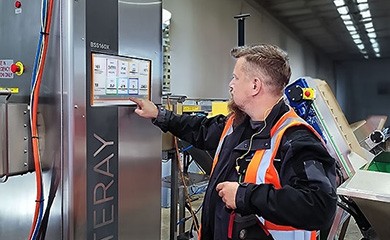
X-LINEView gives operators of baggage inspection systems remote control over their installed scanners. In a standalone setup, a failed unit closes one station. In an inline line, it can stop everything upstream, so early fault detection is an operational requirement rather than a convenience.
Preventing downtime. The software tracks more than 100 operating parameters per scanner. Smart failure notification alerts the service team to developing issues so they can be resolved before a unit goes offline. AI-based data analysis identifies usage patterns and trends across the installed base and supports informed decisions about maintenance scheduling and equipment load.
Optimizing operation. Operator activity monitoring tracks screener performance and keeps an audit trail of operational decisions, which highlights where additional training is needed. A device digital twin provides a virtual replica of the system. Teams can simulate scenarios and test new configurations, such as a revised lane setup for an upcoming event, without disrupting the live line.
Security and integration. Telemetry data is transmitted over an encrypted channel. The software integrates with existing IT and security infrastructure. Online and offline modes keep scanner data accessible to authorized personnel even when a site’s connectivity is limited.
Benefits of Inline Screening
Throughput that holds at peak. Removing manual loading and automating primary screening lifts the two main bottlenecks of standalone screening.
- Lower labor per item. Operators resolve alerts instead of reading every image, and handlers no longer lift items on and off the scanner.
- Safer working conditions. Less repetitive lifting reduces strain injuries. In mail and property screening, fewer items are opened by hand before they are imaged.
- Consistent decisions. AI primary screening applies the same criteria to every item and every shift, and operator decisions can be audited.
- Better visitor experience. At entrances, people keep walking rather than waiting through a hand search, which matters for venues and schools that need to stay welcoming.
Why Security Teams Choose LINEV Systems
LINEV Systems has specialized in X-ray inspection for personnel, baggage, parcel, and cargo screening since 2006. Its equipment is deployed in correctional facilities, at border crossings, in government buildings, and at transportation hubs, and it is backed by 24/7 support, remote diagnostics, and maintenance services (Police1). Its peak-flow screening has received independent recognition. In March 2026, LINEV Systems UK won the ADS Security Innovation Award at the Home Office’s Security & Policing Exhibition for LV STREAM (ADS Group, 2026). In addition, LV STREAM was tested under the UK National Protective Security Authority’s High Throughput Bag Screening test method, with results published in NPSA’s Catalogue of Security Equipment (Made in Britain, 2026).
LINEV Systems engineers can assess your peak volumes and item profile and recommend an inline configuration that fits your site.
Sometimes. It depends on whether the scanner’s conveyor can exchange control signals with external conveyors, and whether its tunnel size and belt height match the planned line. Older units often lack these interfaces, so a site assessment comes first.
A mobile bag lane or a single scanner added to an existing conveyor can be operational within days to a few weeks. Multi-lane installations with new conveyors and a dedicated inspection area are construction projects measured in months, and the schedule is usually driven by civil and conveyor works rather than by the scanner.
The dose from baggage X-ray inspection is very low and does not affect electronics, medication, or food. Standard consumer film is generally unaffected by a single pass. High-speed film (ISO 800 and above) can fog after repeated exposure, so hand inspection is advisable for professional film stock.
Systems compliant with 21 CFR 1020.40 are designed so that operators receive no meaningful exposure in normal use. Dosimetry requirements are set by individual states, so confirm them with your state radiation control program during procurement.
Bag screening units are generally designed for indoor conditions. For outdoor or temporary deployments, place them in a weather-protected structure with a level floor, stable power, and controlled temperature. Mobile units suit this use best because they can be moved in and out between events.
Sources
- ADS Group (2026). “LINEV Systems UK wins ADS Security Innovation Award”.
- Corrections1. “‘Sophistication’ of drug smugglers thwarts Ore. mail scanning efforts”.
- Electronic Code of Federal Regulations. “21 CFR 1020.40: Cabinet X-ray systems”.
- KSTP (2024). “Drugs keep finding their way into Minnesota prisons. Did DOC find a solution?”.
- Made in Britain (2026). “LV STREAM tested by NPSA (National Protective Security Authority)”.
- National Center for Education Statistics (2022). “Digest of Education Statistics, Table 233.50: Percentage of public schools with various safety and security measures”.
- Police1. “LINEV Systems: Advanced X-ray screening solutions since 2006”.
- United States Postal Inspection Service (2018). “Annual Report 2018”.