












26 April 2026
Ports Are Processing Thousands of Vehicles a Day and Only a Cargo X-ray Scanner Can Handle That Volume
A modern port has staggering numbers. At a major international crossing on a single day, thousands of trucks and vans, buses and private vehicles go through inspection points. Each vehicle is a possible carrier of contraband or undeclared goods. It could also be a vehicle for people, weapons, and/or illegal immigrants. Each of them represents a business with a supply network, a driver who has a schedule, and an economy that depends on the freight moving quickly. It is not a theoretical tension, but it plays out at major border crossings around the world every hour. Manual inspection methods have never been designed to solve this tension. The cargo X-ray scanner does more than just reduce tension. It is the only way to manage the volume of cargo that modern ports deal with.
The traditional cargo inspection model, which included physical searches, document checking, and the occasional use of detection canines, was designed for a time when cross-border commerce moved at only a fraction of what it does today. The volume of global trade has grown rapidly over the last two decades. The infrastructure responsible for protecting that movement is struggling to keep pace. It is not feasible to add more inspectors. When you have to deal with thousands of cars per day and maintain both flow and security, the math does not work
The Problem No One Wants to Talk About
An ugly reality lies at the heart of border security operations. At most high-volume crossings, only a small percentage of vehicles are physically inspected on a given day. The rest are cleared based on paperwork, risk profiling, and the practical difficulty of doing anything more thoroughly within the time and staffing constraints. This is not a failure of aim, but of capacity. Inspection teams do not cut corners because they lack diligence. They are making triage choices since the volume of traffic prevents full manual checking.
This is the environment in which major threat actors work. They comprehend math as well as anyone. A package concealed within genuine commercial goods going through a crossing that physically inspects only a portion of what passes through has a calculable likelihood of discovery that is significantly lower than most people would be comfortable admitting. The only significant solution to this reality is to completely alter the inspection capacity equation, which is exactly what deploying a cargo X-ray scanner across high-volume lanes accomplishes.
The scale problem is also a consistency issue. Manual inspection quality varies according to shift schedules, tiredness levels, experience, and the need to maintain flow during peak periods. An X-ray system does not have a negative shift. It does not rush since a wait is forming. It scrutinizes the hundredth vehicle as much as the first, and consistency is a potent deterrent in and of itself.
The traditional cargo inspection model, which included physical searches, document checking, and the occasional use of detection canines, was designed for a time when cross-border commerce moved at only a fraction of what it does today. The volume of global trade has grown rapidly over the last two decades. The infrastructure responsible for protecting that movement is struggling to keep pace. It is not feasible to add more inspectors. When you have to deal with thousands of cars per day and maintain both flow and security, the math does not work
The Problem No One Wants to Talk About
An ugly reality lies at the heart of border security operations. At most high-volume crossings, only a small percentage of vehicles are physically inspected on a given day. The rest are cleared based on paperwork, risk profiling, and the practical difficulty of doing anything more thoroughly within the time and staffing constraints. This is not a failure of aim, but of capacity. Inspection teams do not cut corners because they lack diligence. They are making triage choices since the volume of traffic prevents full manual checking.
This is the environment in which major threat actors work. They comprehend math as well as anyone. A package concealed within genuine commercial goods going through a crossing that physically inspects only a portion of what passes through has a calculable likelihood of discovery that is significantly lower than most people would be comfortable admitting. The only significant solution to this reality is to completely alter the inspection capacity equation, which is exactly what deploying a cargo X-ray scanner across high-volume lanes accomplishes.
The scale problem is also a consistency issue. Manual inspection quality varies according to shift schedules, tiredness levels, experience, and the need to maintain flow during peak periods. An X-ray system does not have a negative shift. It does not rush since a wait is forming. It scrutinizes the hundredth vehicle as much as the first, and consistency is a potent deterrent in and of itself.
What High-Volume Screening Actually Requires
Deploying X-ray inspection at a port or border crossing that handles thousands of vehicles per day is not simply a matter of installing equipment and walking away. The operational demands of high-volume environments place specific requirements on any screening solution:- The system must process vehicles without requiring them to stop, minimising disruption to traffic flow and keeping dwell times as low as possible.
- Image quality must be high enough to allow reliable threat detection across a wide range of vehicle types, cargo configurations, and concealment methods.
- The system must be capable of operating continuously across extended periods without performance degradation.
- AI-assisted detection must be integrated to support operators who are reviewing large numbers of images under time pressure.
AI Transforms What an Operator Can Do
Volume challenges do not stop when the vehicle passes through the scanner. The volume challenge continues after the vehicle has passed through the scanner. A human operator will then review the image and make a quick decision, often under pressure of time and as the next vehicle approaches. AI-assisted vehicle detection is no longer a luxury but a necessity. LINEV Systems has integrated AI threat detection into its cargo screening solutions, because we know what operators face in the field. It is not a system of security that relies on the human eye to detect every anomaly. Instead, it is a system of lottery. AI can change that by automatically flagging areas of interest in scanned images. This will draw the operator’s focus to hidden objects, density anomalies, or shapes consistent with contraband or weapons. It does not replace an operator. This focuses their attention. It preserves the irreplaceable human decision-making ability, such as contextual judgment, experience, and situational awareness, which is not spread out over thousands of routine scans. This results in a detection ability that increases with volume, rather than deteriorating.The Case for Drive-Through Inspection at Scale
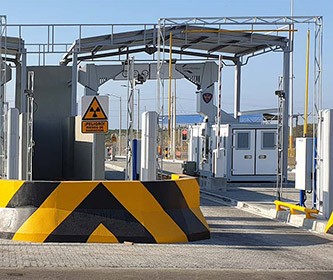
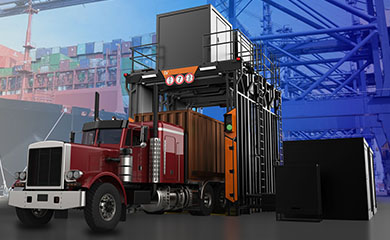
One of the most significant developments in cargo and vehicle screening over recent years has been the refinement of drive-through inspection systems that can handle occupied vehicles, large trucks, and passenger buses without requiring anyone to exit the vehicle or halt the flow of traffic. This is not a marginal improvement on older technology ,it represents a fundamental shift in what border inspection can look like at scale. The operational advantages are considerable:- Traffic lanes remain active during screening, preventing the queuing and congestion that physical inspection points create.
- A single system can process vehicles across a range of sizes and configurations, from private cars to articulated lorries, without requiring lane changes or separate processing streams.
- Screening data is captured and logged automatically, creating an auditable record of every vehicle that passes through without additional administrative burden on inspection staff.